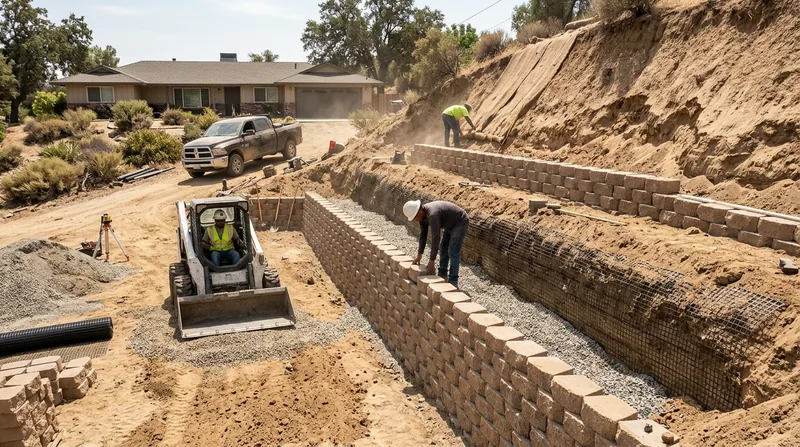




Bakersfield sits on the flat floor of the southern San Joaquin Valley, but the flat ground ends fast. Along Panorama Drive in the northeast, homes perch on steep bluffs above the Kern River, and the foothill lots east of town climb into loose sandy loam and silt. One heavy winter storm sends that soil downhill, and a clogged weep hole or a saturated lawn pushes it faster. Slope Stabilization & Erosion Control in Bakersfield means holding that ground in place before it takes a driveway, a patio, or a foundation wall with it. We build terraced retaining walls, set geogrid reinforcement, and install erosion control that fits the bluff lots and the alkaline, hardpan pockets under this city. If your slope is already moving, start with leaning and collapsed wall repair before the damage spreads.
Why Slope Stabilization Matters on Bakersfield Bluffs and Foothill Lots
Most of Bakersfield is flat, so the slope problems concentrate where the ground actually drops: the Kern River bluffs above Panorama Drive, the rising lots in the northeast foothills, and the terraced backyards in Rosedale and Seven Oaks. The soil here is sandy loam and silt with alkaline and hardpan pockets, which drains fast until it saturates, then slides. Constant lawn irrigation keeps the backfill wet year round, and the rare but heavy winter storms finish the job.
- Irrigation saturates sandy backfill behind walls and turns it into a slow-moving mass.
- Winter storm runoff cuts gullies down unprotected bluff faces above the Kern River.
- Clogged weep holes trap water behind block and CMU walls until they lean.
- Hardpan pockets perch water and create soft spots under footings and driveways.
- Aging timber planters rot and release the soil they were holding on terraced lots.
Each of those failure modes shows up in a different part of town, and each one needs a different fix.
Key info: A split-face CMU wall on a Panorama Drive bluff lot can look fine from the patio while the sandy backfill behind it has already lost bearing. We probe the soil and check the weep holes before we quote any stabilization work.
The City of Bakersfield Building Department sets the permit thresholds for walls and grading, and those thresholds vary with height and surcharge. Verify the current rules with the department before you schedule work: City of Bakersfield.
How We Stabilize a Bakersfield Slope, Step by Step
We start by reading the slope, not by selling a wall. On a foothill lot east of town, that means checking where the water comes from, how steep the face runs, and what sits at the top and bottom. Then we build the fix in layers: drainage first, structure second, surface protection last. The order matters because a retaining wall that holds water fails no matter how heavy the block.
- We walk the slope and mark the wet zones, the cracks, and the structures at risk.
- We test the soil for hardpan and sandy pockets that need over-excavation.
- We cut the slope into terraces so no single wall carries the whole load.
- We set geogrid reinforcement in lifts behind the wall face.
- We install drainage, filter fabric, and weep holes before backfilling.
- We finish the surface with erosion control that holds seed and soil in place.
That sequence is what keeps a wall standing through a wet winter and a dry summer alike.
Key info: On a Rosedale lot with a terraced backyard, the upper tier had no drainage at all. Water from the lawn ran straight into the lower wall's backfill. We tied the tiers into one drainage system, and the lower wall stopped moving.
For the drainage side of the work, see retaining wall drainage, and for the structural build, retaining wall installation.
Stabilization and Erosion Control Methods We Use Around Bakersfield
No single method fits every slope. A river-rock face above the Kern River bluffs calls for a different approach than a sandy foothill cut in Bear Valley Springs. We match the method to the soil, the grade, and what the slope is protecting.
| Approach | Description | Best for |
|---|---|---|
| Terraced retaining walls | Two or more shorter walls stepped up the slope instead of one tall face. | Steep backyard lots in Seven Oaks and the northeast foothills. |
| Geogrid reinforcement | Grid layers set in compacted lifts tie the wall face into the soil mass. | Tall segmental block walls and walls under driveway surcharge. |
| Boulder and rock slope protection | Placed rock armor holds the toe and breaks up runoff energy. | Kern River bluff faces and washout gullies after winter storms. |
| Surface erosion control | Filter fabric, netting, and drought-tolerant cover hold bare soil. | Newly cut slopes and bare ground above retaining walls. |
| Drainage and weep hole retrofit | Drain pipe, gravel, and cleaned weep holes move water out of the backfill. | Walls already showing lean, seepage, or saturated soil. |
Slope Stabilization & Erosion Control Cost in Bakersfield: What to Expect
Every slope job starts with a free estimate, because the number depends on the ground, not on a price sheet. A short terraced wall on a flat Rosedale lot is one job; a 12-foot bluff face above Panorama Drive with saturated sandy loam is another. We quote after we walk the slope, probe the soil, and see how equipment reaches the work area.
- Slope height and length drive how much wall, geogrid, and rock the job needs.
- Access matters: a backyard slope behind a narrow gate costs more to build than a street-side face.
- Soil conditions, including hardpan and sandy pockets, can require over-excavation and engineered fill.
- Proximity to structures raises the stakes when a patio, pool, or foundation sits at the top of the slope.
- Drainage work, permits, and engineered drawings add scope on tall or tiered walls.
Get two or three estimates and compare what each one includes, not just the bottom line. A low quote that skips drainage or geogrid is not the same job. Our pricing overview explains how we build an estimate.
Hiring a Retaining Wall Contractor Near Me in Bakersfield: What to Check
Slope work is structural work, and the contractor you pick should be able to prove it. Then ask how they handle drainage, because a contractor who quotes a wall without a drainage plan is quoting half a job.
- Confirm the contractor is fully insured, and get the certificate in writing.
- Get two or three written estimates that list materials, drainage, and reinforcement.
- Ask for references from Bakersfield jobs on slopes similar to yours.
- Check whether the City of Bakersfield Building Department requires a permit for your wall height or surcharge.
- Check HOA rules for wall height, materials, and setbacks before work starts.
We answer those questions on the first call, and we put the scope in writing. Reach us at contact and free estimate or call (661) 387-2265.
Slope Stabilization & Erosion Control in Bakersfield: Pricing Guide
| Service | Price | Details |
|---|---|---|
| Slope inspection and stabilization plan | Free estimate | On-site walk of the slope with soil probing, drainage check, and written scope before any number is quoted |
| Terraced retaining wall stabilization | Starting at $4,500 | Includes excavation, geogrid reinforcement, drainage, and backfill; slope height and access move the price |
| Boulder and rock slope protection | Starting at $3,200 | Placed rock armor at the toe and in washout gullies; rock size, haul distance, and slope grade affect cost |
| Drainage and weep hole retrofit | Starting at $1,800 | Drain pipe, gravel, filter fabric, and weep hole cleaning; wall length and backfill saturation drive the total |
| Complex bluff or engineered slope job | On estimate | Needs an on-site look at soil, surcharge, and permit requirements before we quote a number |
| Travel | Included | in Bakersfield and surrounding areas, no separate call-out or mileage fee |
Indicative pricing, the exact cost depends on square footage, finish, and site access. Free personalized estimate within 24h at (661) 387-2265.


